


Ireland – Dublin Stations

We stayed in a fantastic small hotel overlooking Howth marina and harbour with views over the Irish Sea and Dublin Bay. We also enjoyed a lovely meal at The Abbey Tavern, a well know pub for Trad Music, unfortunately not on the night we visited though. After an equally delicious breakfast in our hotel we packed the car up and took a short drive over to the Lifeboat Station on the other side of the marina. We were visiting just two stations today, Howth at the north of Dublin Bay and Dun Laoghaire on the south side.
Howth Lifeboat Station

We were a little early so took a photo of the station as our evidence, the Trent Class moored on its pontoon, and strangely, their D-Class also moored on the pontoon.
Shortly after we were joined by Lifeboat Operation Manager Colm who welcomed us to the station but had to quickly dash of for half hour, so he let us into the station to wait for him.
In the meantime the mechanic arrived and we startled him but once he knew what we were doing and how we got in, he was fine. Colm returned shortly after and kindly gave us a tour of the station. He explained that the D-Class was on a mooring as it had been decontaminated the day before.
A lifeboat was first stationed at Howth in 1817 by the Corporation and Port of Dublin. The RNLI assumed management of the station in 1862. A new station building was constructed on Howth Middle Pier in 1984, on reclaimed land from the 1982 harbour development. In 2016, a new pontoon berth was constructed alongside the lifeboat house.
In 2002, the Trent-class lifeboat 14-33 Roy Barker III was placed on service. Mr Frederick Roy Barker, known as Roy, left his entire estate to the RNLI, known as the Roy Barker Memorial Fund, with the request that all income be used to fund lifeboats. Howth received one of three Trent-class lifeboats from the fund. However, the lifeboat moored on the pontoon at the time of our visit was a relief boat, 14-17 Elizabeth and Ronald as Roy Barker III was undergoing a refit and would be returning the following week.
The D-Class lifeboat is D-796 Aideen Cresswell, funded from the bequest of the late Mrs Aideen Cresswell, who died in 2011, aged 91.
We gathered a few more photos of the lifeboats and wished Colm well before leaving for our second and final visit of the day.
Dublin is a large and very busy city. There were a couple of choices to get to the south side, through the middle or round the busy ring road, the M50. On a good day, not a lot of difference in time but double the mileage going around the outside. In the end we opted for the direct route and managed to reach the harbour town of Dún Laoghaire in good time.

Dún Laoghaire Lifeboat Station
Another one of those locations where the name has been anglicised to Dunleary. We arrived early and parked opposite the Royal St George Yacht Club and paid for a couple of hours on the ticket. At the station we visited the shop and had a lovely chat with volunteer Pat. After purchasing a station badge we headed round to the station steps where we were warmly welcomed by Operations Manager and Launch Authority Eamon. We were joined in the crew room by ALB crew Hazel and Ronan where we had a great discussion and banter over a cup of tea and biscuits.
As with Howth in the north, Dun Laoghaire was one of seven strategically placed lifeboat locations operated by the Corporation and Port of Dublin to cover the vast numbers of ships that entered Dublin Bay and its busy port. Opened at around the same time in 1827 and taken over by the RNLI in 1862, the station saw many boathouses coming and going before the current station building was constructed in 1998 on the same site as a 1901 boathouse. Their D-Class lifeboat is housed in the boathouse constructed in 1862.
Eamon kindly took us to this boathouse just a few metres away and showed us around. If it wasn’t for the modern D-Class lifeboat we could imagine it just as it was in the 1800’s. The D-Class is called Joval (D-865) on station since 2022.
Moored in the harbour was their Trent Class, Anna Livia (14-05) on station since 1995. We discussed with Eamon the future of Anna Livia and whether there were plans to potentially receive a new coastal class lifeboat undergoing sea trials with the RNLI.
The station is one of the busiest in Ireland and Eamon recalled some of the bigger rescues and also some great tragedies that they have suffered. We visited the memorial to fifteen lifeboat men that lost their lives in the Kingstown Lifeboat Disaster of 1895.
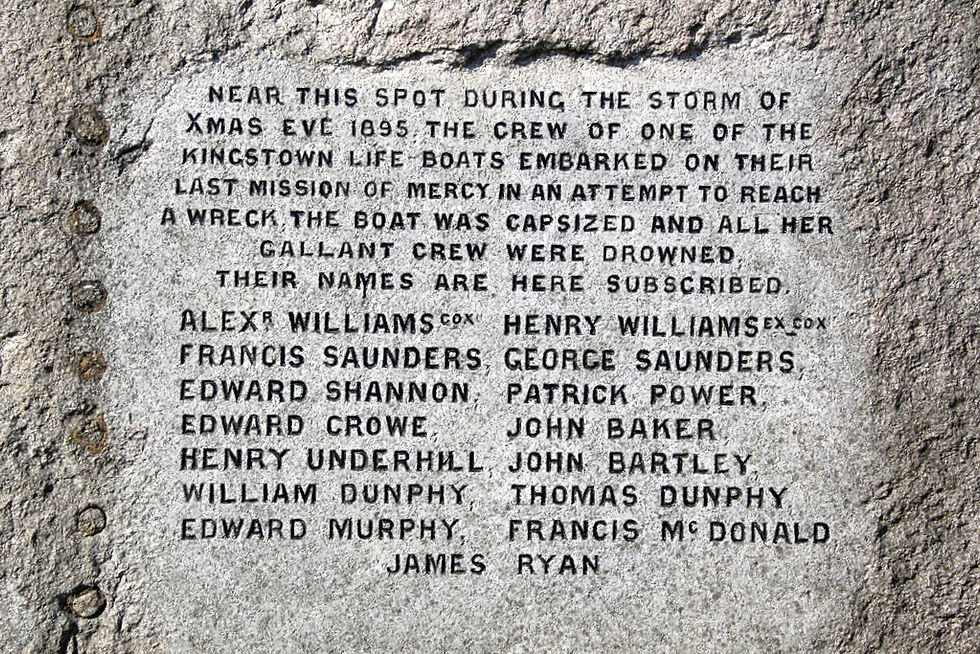
In a Christmas Eve storm of 1895, the Russian barque Palme, on passage from Liverpool to South America, was seeking shelter in Dublin Bay. With her anchor dragging, and in danger of being driven ashore, the Kingstown No.2 lifeboat Civil Service No.7 was launched, with a full complement of 12 crew, plus Coxswain, Second Coxswain and Bowman.
In full public view, when just 550 metres from the Palme, a huge wave capsized the lifeboat. It didn't self-right, maybe due to damage to the air-boxes. All 15 lifeboat men were lost. Efforts to launch the Palme's ship's boat, to rescue the rescuers, failed, when it was smashed by the waves.
The Kingstown No. 1 Lifeboat Hannah Pickard was also launched, with nine lifeboat men, and six men from HMS Melampus. It too was capsized, although this time, the No.1 lifeboat self-righted, and all the crew managed to regain the boat. Sighting the upturned No.2 lifeboat, they continued to search for survivors for 45 minutes, until oars were lost in the terrible conditions, and the No. 1 lifeboat was driven ashore at Blackrock. Further attempts to reach the vessel, by the Poolbeg lifeboat Aaron Stark Symes, and two tug boats, also failed, and the Palme, for now, was left to her fate.
The following day, the steamship Tearaght managed to reach the vessel, and the Master, his wife and child, 17 crew, and the ship's cat, were saved. Capt. Thomas McCombie of the Tearaght was awarded the RNLI Gold Medal. A fund for the families of the lifeboat men lost was set up, with £2200 coming from the Institution. £300 was given to the families by the Russian Government. The No.2 lifeboat was beyond repair, and the station was closed for the next three years.
After a fantastic discussion with Eamon and some more photos, we headed back to the crew room and said our farewells. It was such an amazing visit that we lost track of time and unfortunately received a parking ticket for our troubles – annoying to say the least.


Comments