


Ireland – The Beginning
- Allan & Helen

- Apr 30
- 6 min read
We travelled from home to Newport in South Wales on the Friday night and then on to Fishguard the following morning. It was glorious warm calm weather which was reassuring for our crossing of the Irish Sea. Before heading to the port we visited the little Artisan shop that sold RNLI merchandise to get a pin badge from Fishguard Lifeboat Station. On our visit last year the shop was unfortunately closed.
Our ferry across the Irish Sea to Rosslare was due to depart at 2pm and we checked in early and relaxed in the afternoon sun before boarding. The crossing was smooth as expected and a few hours later we arrived in Ireland.
Our first night was spent in a beautiful B&B just outside the small town of Wellingtonbridge. Pauline, the owner, was an amazing host and the room was very comfortable. The breakfast on Sunday was delicious and set us up very well for the day ahead.

Kilmore Quay Lifeboat Station
A short 20 minute drive from our accommodation was the lovely harbour town of Kilmore Quay. It was busy when we arrived with visitors heading out to enjoy various sea based activities. We found a parking space and headed to the harbour to take a couple of photos of the lifeboat. The lifeboat station was just a short walk up the main street but when we arrived, some of the crew were rushing out and informed us that they had been paged. So we headed back to the harbour ready to watch from over the wall. We then heard our names being called and were met by Grainne who was the fundraising officer for the station. She asked us to come with her to watch the launch from the pontoon which was a nice surprise. As the boat was preparing to depart we met some of the crew. After it had left the harbour we headed back to the station where we enjoyed a lovely cup of tea and chatted about our challenge and heard all about the station and also the shout that the boat was heading out on.
The first lifeboat was stationed at Kilmore Coastguard station in 1847 but withdrawn 10 years later. There is no record of a lifeboat at Kilmore again until 1884 when the RNLI decided to establish a lifeboat station because of the dangers around the Saltee Islands. A boathouse was built served until 1992 when it was demolished and a larger building constructed on the same site. In 2004 a new berth was provided at the marina so that the lifeboat could be kept afloat
The current lifeboat that we saw depart the harbour on its ‘shout’ is a Tamar Class, 16-18, Killarney, which arrive on station in 2010.
After our photos we said our goodbyes and headed back to the car. Thank you so much to Grainne, Teresa, Johnny, Phil, Michelle, Conor, Aidan, Robbie, Brian ad Joe for taking the time to meet us. A fantastic start to our first day in Ireland.

Fethard
The next stop was Fethard. When we arrived the gate was open and so we drove in and parked up, there was no sign of anyone else so we duly took our evidence photo and had a look around. Soon after, Natasha, an ILB crew member arrived and welcomed us into the station and gave us a tour of their unique station. Acquired in 2002, the converted bungalow now serves the crew with good facilities and a unique 2 door boathouse.
The RNLI first stationed a lifeboat at Fethard in 1886. The station had been scheduled for closure in 1914, when it was decided to place a motor-powered lifeboat at Dunmore East, but the station was closed prematurely, after nine of the 14 crew lost their lives during the rescue of the crew of the Norwegian schooner Mexico. She got into difficulties during a gale on the afternoon of Friday 20 February 1914. It had a crew of ten and was carrying a cargo of mahogany from South America to Liverpool but ran aground on South Keeragh Island. The Fethard lifeboat launched to rescue the crew from the Mexico. The lifeboat was about 46 metres from the wreck when a large wave swamped it and it too was driven against the rocks.
A station was re-established at Fethard, when an inshore lifeboat was placed there in 1996
The current Lifeboat is a D-Class, Naomh Dubhan (D-819) on station in 2018.
Six of Fethard's previous lifeboats were funded or maintained by the trust of Helen Blake from Sussex. When she died in 1876, a large portion of her estate was bequeathed to the RNLI to fund 2 lifeboats to be based in Ireland.
After saying farewell, we headed further south to the Hook Head Lighthouse where we had a little time to enjoy the glorious view in the sunshine and take a photo of the impressive lighthouse. We then headed back up the estuary to a small ferry which took us the short hop across the River Suir. Our next stop was the beautiful little village of Dunmore East

Dunmore East Lifeboat Station
We parked up next to the station and took our evidence photo before being warmly welcomed by several crew members and shop volunteers who took us up to the crew room where tea and cakes were awaiting our arrival.
We were given a tour of the station and shown a D-Class (D-836) and a Landrover in the station. They explained that this boat and landrover were used as spares for flank stations, mainly Fethard, indeed the outboard motor from the boat was missing and was being used by Fethard during maintenance of their own. The landrover was also used to support Fethard during maintenance periods. Dunmore’s Lifeboat is a Shannon class, William and Agnes Wray (13-41) on station in 2021
The lifeboat station was established in 1884, closing in 1919. It reopened in 1925 and has been served by 8 lifeboats since,
A huge thank you to Shirley, Liz, Bill, Oscar, Jonathan, Sally, Christine and Dave for their very kind welcome and hospitality.
We purchased a pin badge in the shop and said our farewells before heading further along the coast to the village of Tramore.
Tramore Lifeboat Station
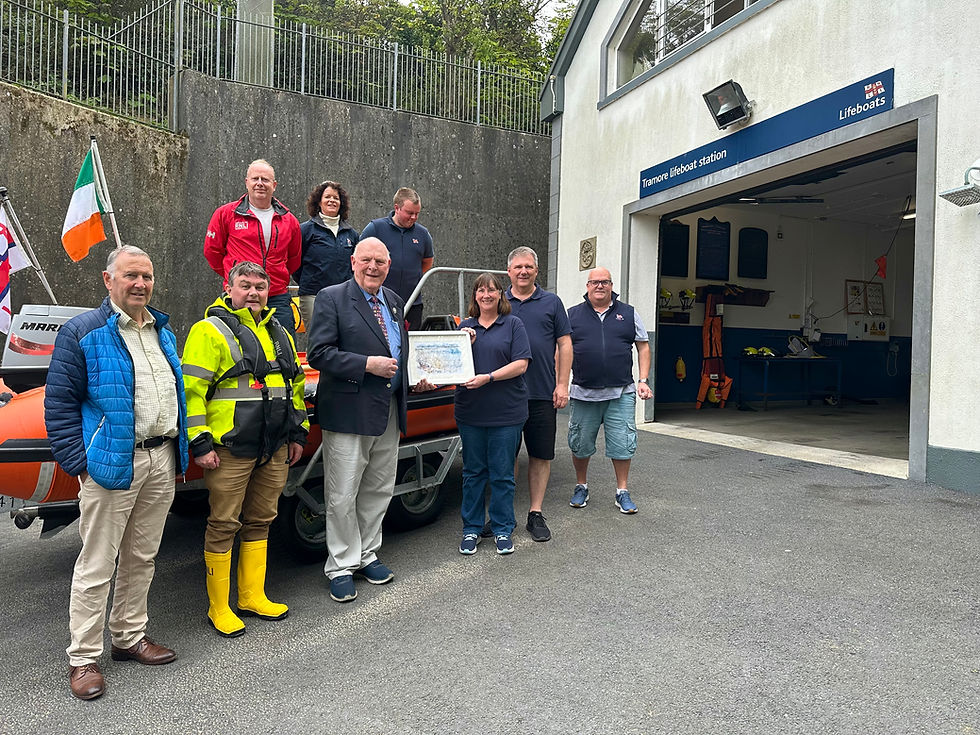
Several crew were awaiting our arrival at the station and we were again warmly welcomed into the crew room where the kettle was on and more cakes and biscuits were to be consumed. Shortly after our arrival the station Chairman, Frank, arrived and explained the history of the station. What an incredible narrator he was, fascinating to hear about the station from someone so knowledgeable. We were then extremely surprised and overwhelmed by a presentation of a beautiful framed print of Tramore Beach.
The station was first established by the RNLI in 1858 before closing in 1923. Tramore is the first lifeboat station in Ireland to be served by an Inshore Lifeboat. It reopened in 1964. The original boathouse sits at the bottom of the road nearest to the harbour. In 1996 the current boathouse was constructed. The original is now used to house a Community Lifeboat.
The crew very kindly took us down to the boathouse and took their D-Class and Tooltrak out of the boathouse so that we could take some presentation photos and learn more about the station and area history.
The current D-Class lifeboat is Isabella Purchase (D-781), funded from the estate of the late Mrs Ivy Purchase, known as Isabella, of Midhurst, West Sussex, a long-time supporter of the RNLI, until her death in 2012
As we walked along the harbour wall we were afforded stunning views of the coastline and the crew explained about the “Metal Man”. The Metal Man stands on one of three pillars near Newtown Cove, the maritime beacons were constructed through Lloyds of London at the behest of the Admiralty after the tragic loss of 360 lives after HMS Seahorse sank after becoming grounded at Brownstown Head in bad weather, this tragedy happened in 1816. At the end of the pier we were able to see the pillars high on the cliff top.
After getting back to the station the crew showed us a community lifeboat and explained that this was used as a back up to the RNLI lifeboat. It was an ex D-Class and housed in its own boathouse just down the road from the Tramore RNLI station.
A huge thank you to Frank, Eamon, Michael, Fergal, Noirin, Lee, Alan and Kieran for meeting us.
After saying our goodbyes we headed along the “Copper Coast” to our accommodation. Exhausted after just the first day but so thankful to everyone that took time out of their weekends to meet us and make us so welcome. Time for the first pint of Guiness.


Comments